
Data Governance Diagnosis
Data Governance Assessment
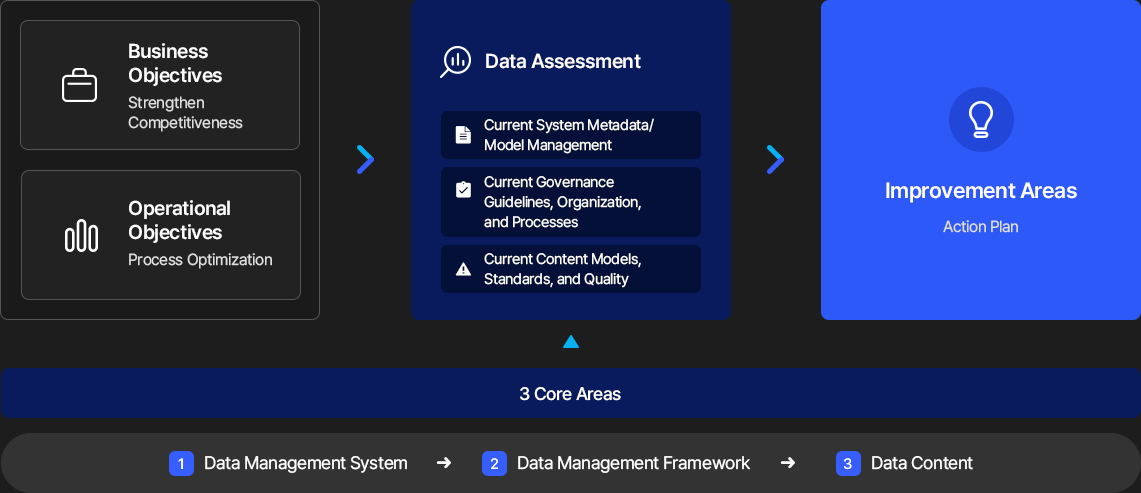
Measure data management status and identify governance issues
to define improvements for stronger competitiveness.
-
Business Process Diagnosis for Greater Competitiveness
Analyze core business flows, remove redundant steps, and redesign processes.
Reorganize data-linked operations for greater agility in changing markets. -
Cost Savings Through Process Optimization
Eliminate time and physical waste to reduce operating costs.
Focus freed resources on key priorities for higher productivity. -
Seamless Cross-Department Communication
Use standardized guides and shared processes to remove collaboration bottlenecks.
Reduce communication costs and accelerate execution toward shared goals.



Optimize Processes Through Data Assessment
Remove data-flow bottlenecks to maximize resources and cut costs.
Standardized governance removes communication barriers, enabling faster decisions and agile execution.
- Data Governance Assessment Framework
Data Standard Diagnosis
Data Standard Diagnosis
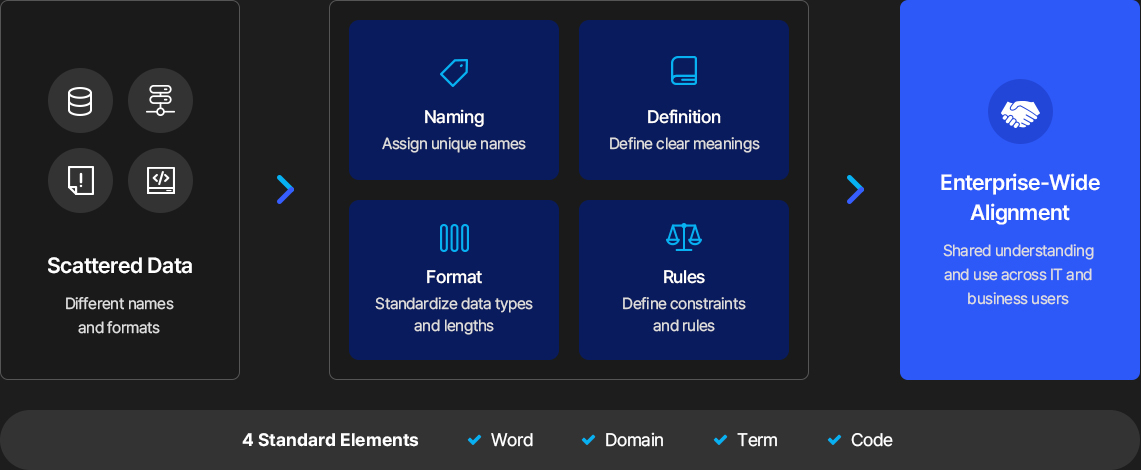
Data standards define and manage names, definitions, formats, and rules for data across systems.
Assess standards management and identify improvements.
-
Enterprise Data Standards for
Consistent Data AssetsEstablish enterprise guidelines for consistent data quality.
Apply them across the data lifecycle to improve transparency and governance. -
Unified Enterprise Terms and Naming Standards
Define standard words and terms to prevent inconsistent interpretation.
A common language improves collaboration and enables faster decisions. -
Consistent Data Use Through Easier Identification
Standardize definitions and structures so everyone can identify and interpret data consistently.
Lower data-use barriers and strengthen enterprise data literacy.



Establish an enterprise-wide standards management framework to ensure data
consistency and enable rapid decision-making based on a common business language.
Unify data naming conventions and formats across disparate systems to strengthen enterprise-wide integration.
Establish a standardized business language to eliminate communication barriers and improve data literacy,
laying the foundation for data to become a practical asset that everyone can understand and use consistently.
- Data Standards Assessment and Management Framework
Data Quality Diagnosis
Data Quality Diagnosis
Define data quality processes, assess current quality levels, and propose improvements.
-
Quality Management for
Trusted Data AssetsAssess accuracy and consistency to secure reliable data for business decisions.
Maximize practical data use and foster a data-driven culture. -
Continuous Quality Management
Establish lifecycle-wide processes for sustained data quality.
Set metrics and continuous monitoring to keep data valuable and responsive. -
Root-Cause Analysis for Data Integrity
Analyze data lifecycle vulnerabilities, not just visible errors.
Address technical and management causes to protect integrity
and reduce costs and risks.



Enterprise Quality Governance for Data Value and Trusted Decisions
Go beyond cleansing with lifecycle analysis and continuous monitoring to prevent errors at the source.
Build a virtuous cycle of high-quality, practical data.
- Data Integration Modeling Process
-
-
Policy
Enterprise-wide principles and guidelines
-
Organization
Quality management roles and responsibilities
-
Process
Quality measurement and change management
-
Elements
Key quality management items
-
System
Supporting tools and systems
-


Key Data Quality Metrics and Criteria
-
DQI
Data Quality Index
A metric for measuring data quality
(completeness, validity, accuracy, etc.) -
CTQ
Critical To Quality
Key business data that directly impacts
customers, processes, and markets -
BR
Business Rule
Business-specific rules for accurate data management
Data Model Diagnosis
Data Model Diagnosis
Verify that data requirements, business rules,
and logical structures are fully and accurately defined for system development.
-
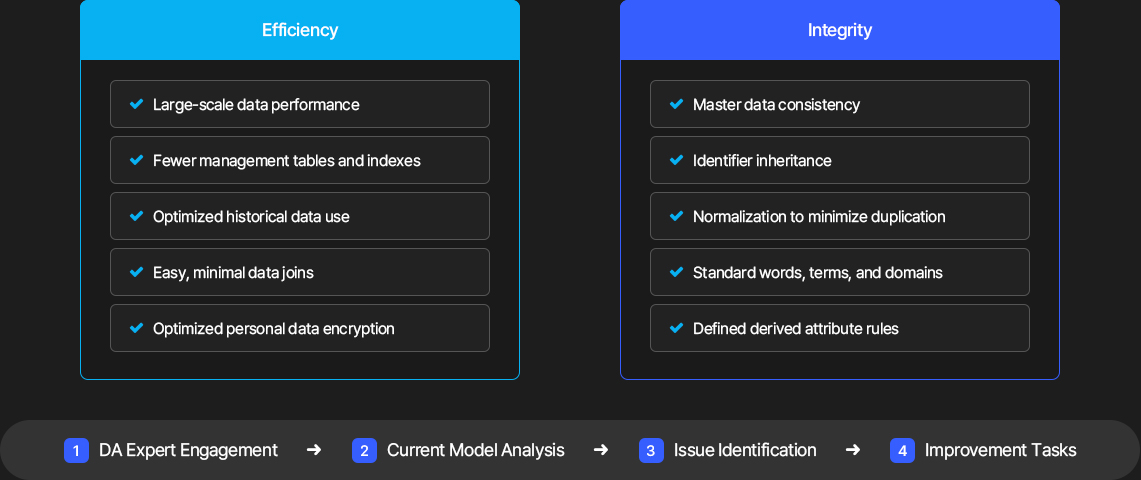
Data Model Integrity and Architecture Assessment
Analyze model fitness and consistency to identify management limitations and technical debt.
Find operational bottlenecks and establish a foundation for stable data asset management. -
Root-Cause Analysis and Improvement Priorities
Analyze causes of key defects, including data duplication and complexity.
Set improvement priorities to manage future upgrade risks. -
Practical Improvements for Next-Generation Systems
Propose a roadmap for a scalable, flexible To-Be system.
Design high-quality data structures for evolving business needs.



Next-Generation Roadmap Through Data Model Assessment
Resolve technical debt and bottlenecks with scalable data structures for agile change and asset value.
- Data Model Assessment Criteria
Data Performance Diagnosis
Data Performance Assessment
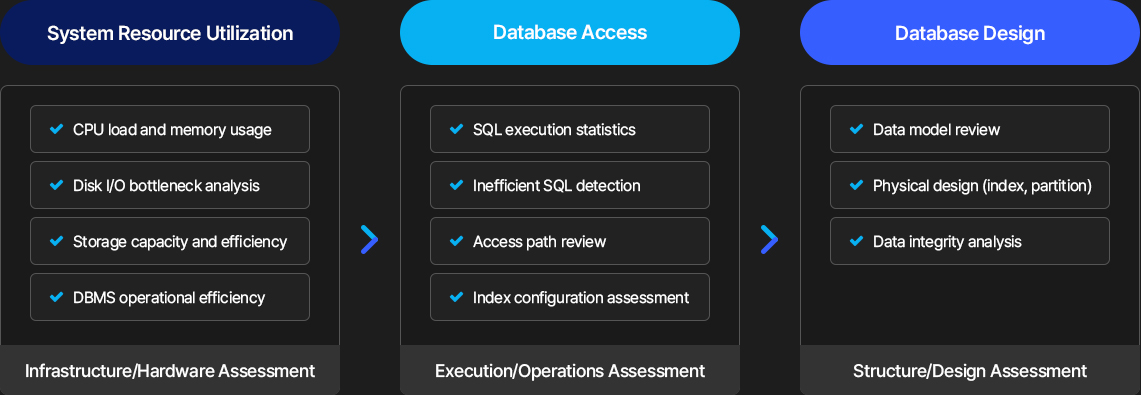
Data performance reflects hardware, model design, and SQL access paths.
encore begins with access path diagnostics to identify system-wide issues and recommend solutions.
-
Hardware Resource Assessment
Analyze server utilization to identify availability, waste, and hardware bottlenecks.
Provide a basis for model and SQL access path optimization. -
Data Model and SQL Access Path Optimization
Optimize hardware, models, and SQL access paths to resolve performance issues.
Accelerate core business logic with a high-performance data architecture. -
Performance Verification
Monitor server usage after optimization to verify performance gains.
Improve efficiency and response times without infrastructure expansion.



System Performance Through H/W and SQL Optimization
Analyze resource use and access paths to remove bottlenecks, optimize models, and improve IT availability and agility.
- 3-Step Data Performance Assessment
Data Migration Diagnosis
Data Migration Assessment
Data migration is critical to a successful system launch.
encore identifies root causes and provides a validated recovery roadmap for error-free migration on schedule.
-
Early Decision: Fix or Rebuild
Analyze scripts and mapping logic to identify limitations.
Choose between logic fixes and framework redesign to reduce sunk costs. -
Fast-Tracking and Schedule Impact
Identify dependencies, early migration, and parallel processing opportunities.
Remove delays and optimize sequencing for timely, complete migration. -
Guidelines for Repair or Re-Architecture
Analyze scripts and mapping logic to clarify technical limitations.
Use objective criteria to select repair or re-architecture for a successful launch.



Data Model Assessment for Next-Generation Systems
Resolve technical debt and bottlenecks with scalable data structures for change and asset value.
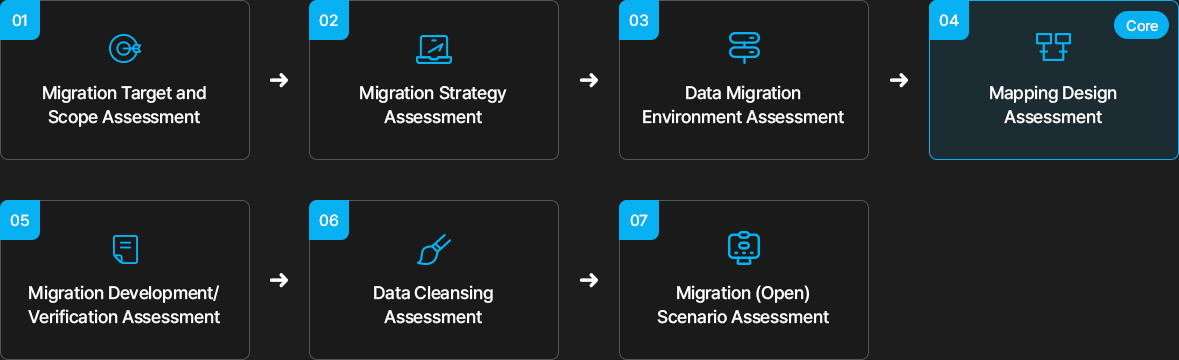
- 7-Step Data Migration Assessment Process
Key Outputs
-
Target Compliance
Migration schedule and effort estimates
-
Direction
Project Reboot vs. Restart decision
-
Recovery Plan
Best practice implementation plan


